

If you’re considering a new heating system for your home, it’s a good idea to conduct a heat loss assessment of the property to ensure that your chosen heating system will keep the space sufficiently warm. In this expert guide, we’ll walk you through the benefits of this kind of energy audit, providing you with a step-by-step walkthrough of how to calculate heat loss. You’ll discover:
- How to calculate the design temperature of a space
- How to work out surface heat loss
- How to calculate air infiltration heat loss levels
- If radiant floor heating will provide enough heat for a property
- The benefits of working with a professional contractor on energy audits
How Can Heat Loss Affect a Home’s Heating System?
‘Heat loss’ describes the amount of heat that escapes a property, typically through its walls, floors, windows and other building elements. So, before installing a new heating system it’s always advisable to conduct a heat loss assessment as part of an overall energy audit to pinpoint areas in your home where such heat loss is occurring so that you can specify the right heating system for your needs. A room with very high levels of heat loss will require a heating system with a much higher heat output than a well-insulated room, for instance – something which can result in inefficient energy usage and in turn, higher running costs.
Looking for more tips on reducing heat loss in your home? Read our informative article to discover everything you need to know.

6 Steps for Calculating the Heat Loss of a Property
Below, you can find a simple step-by-step guide on how to conduct a heat loss assessment for a typical room in your home. The total value is determined by calculating and adding up the heat loss of each surface of the space alongside the heat loss created due to air infiltration. This method aligns with SAP and Part L principles in UK building regulations.
1. Determine Design Temperature
The first step is to find the difference between the ideal temperature inside your home and the lowest average outdoor temperature for your location in winter.
This difference is called ΔT (Delta T).
An example of this for a home in the UK would be:
- Indoor design temperature: 21°C
- Average outdoor winter temperature: 4°C
- ΔT = 21 – 4 = 17°C
2. Calculate Surface Area
Next, you need to measure the total external wall area of a space by measuring each wall and then subtracting the area of its windows and doors.
An example of this for one wall would be:
- Wall length: 7.6 m
- Wall height: 2.4 m
- Area (A) = 7.6 × 2.4 = 18.24 m²
- Windows and doors: 3.3 m²
- Subtraction of windows/doors from total area (A): 18.24 – 3.3 = 14.94 m²
3. Determine U-Value
U-value (measured as W/m²·K) measures heat transfer through an average building element such as a wall, door or window.
Some typical values of these are:
- Uninsulated cavity wall: ~1.5 W/m²·K
- Modern insulated wall: ~0.18 W/m²·K
- Double-glazed window: ~1.4 W/m²·K
- Solid timber door: ~2.0 W/m²·K
- Floors: ~0.15 W/m²·K
- Roofs (pitched): ~0.13 W/m²·K
4. Calculate Heat Loss for Each Surface
The formula for calculating Heat Loss (measured in Watts, referred to as ‘W’) is:
U × A × ΔT
So that’s the U-Value of the building element multiplied by the Area of the individual surface multiplied by the property’s Delta T figure.
An example for a modern insulated wall would be:
- U = 0.18 W/m²·K
- A = 14.94 m²
- ΔT = 17°C
Which means that the total heat loss for this wall would be: 0.18 × 14.94 × 17 = 45.7 W
You should produce the figures for all the windows, doors, ceilings and floors of the space.
5. Air Infiltration Heat Loss
Air infiltration heat loss measures the air that escapes a room through joints in a property’s fabrication as well as cracks around doors and windows.
This figure is measured in Watts and can be worked out using the following formula:
Volume of air in the room (measured in m³) × ΔT × ACH × 0.33
Where:
- ACH = Air Changes per Hour. This refers to the number of times air volume in a room or space is completely replaced in an hour.
- 0.33 = a constant for the capacity of air to store heat
Some example figures for a typical room would be:
Room dimensions of 7.6 m width × 4.6 m length × 2.4 m height = 83.9 m³ Total Volume
ΔT = 17°C
ACH = 1.5
So, therefore the calculation would be:
83.9 × 17 × 1.5 × 0.33 = 706 W
6. Total Heat Loss
To work out the total heat loss level for a space (measured in Watts), simply add up the individual heat loss figures for all surfaces / building elements in the room plus the air infiltration figure of the space:
Walls + Windows + Doors + Ceiling + Floor + Air Infiltration = Total Heat Loss in W
Should I work with a Professional on My Energy Audit?
It is always recommended that you work with a specialist in energy modelling to conduct a thorough heat loss assessment of a property. Those working in this field will utilise the latest technology to expose points of heat loss as well as air and moisture infiltration; identifying these areas yourself is often impossible using a visual inspection as they are hidden beneath flooring, behind walls and above ceilings. However, you can prepare for an energy audit by sealing up the obvious leaks around windows and doors and addressing those areas in your home where insulation is clearly needed.
Will Radiant Floor Heating Provide Enough Heat for My Home?
Nothing is as comfortable as a warm floor during the winter months, and Warmup’s collection of floor heating systems are up to 35% more efficient than traditional heating methods.
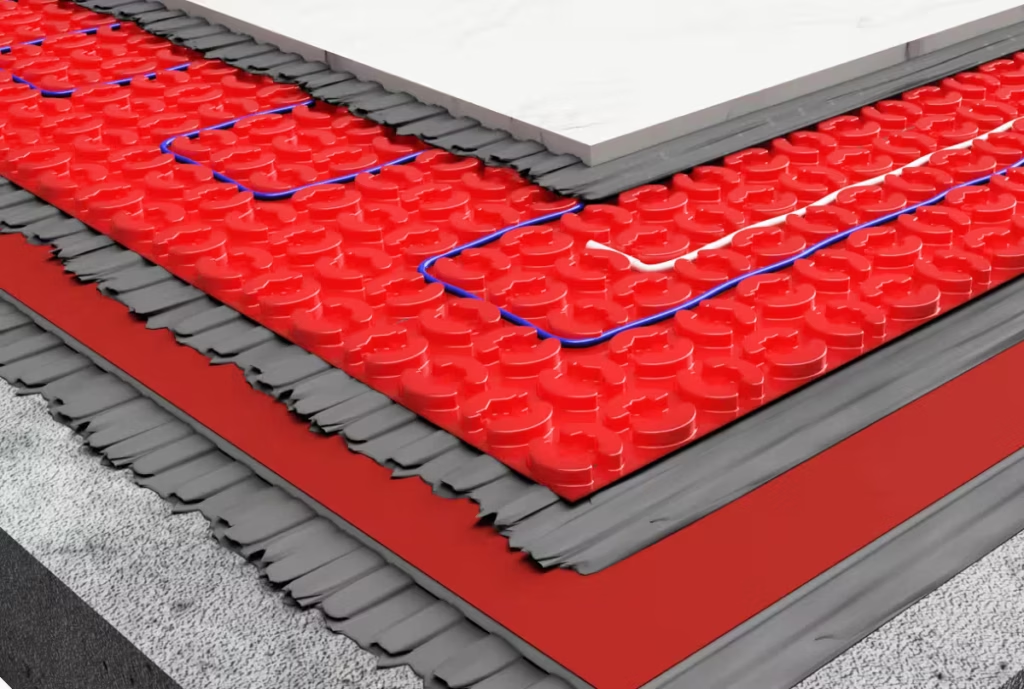
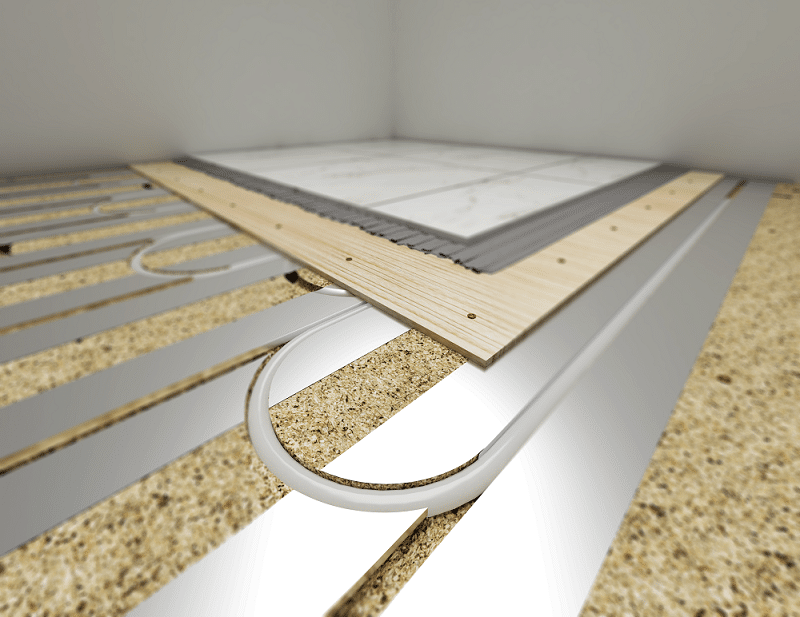
Electric underfloor heating is ideal for providing supplemental heat to just one or two rooms of your home or for use across the entire property if it has sufficiently low levels of heat loss. Water underfloor heating is perfect as the primary heating solution in a whole home. If the heat loss levels of a property are too high, you will need to look at ways to reduce this through improving its insulation levels to ensure the efficient performance of a new floor heating system. Installing good quality floor insulation is a great way to not only dramatically reduce your home’s heat loss levels but also improve the responsiveness of the system itself.
Once you have completed your heat loss assessment and taken the steps needed to improve your home’s energy performance (such as fitting adequate levels of insulation), you should make sure that your chosen system will produce a greater heat output than the property’s heat loss levels. Warmup offer systems at a range heat output levels – including those with a flexible heat output – meaning you can rest assured that you’ll find the perfect system for your home. You can find out more about the heat output of underfloor heating in our in-depth guide.
Ready to purchase a new underfloor heating system? Use our simple online quoting tool to discover the best system for your requirements. If you’re considering a water UFH system, we’ll even show you the heat loss calculations for the specified system – ensuring its heating output will be sufficient for your project.



![Thumbnail [200x250]](/wp-content/uploads/Electric-Category-Page-Image.jpg)
![Thumbnail [200x250]](/wp-content/uploads/Hydronic-Category-Page-Image-1.jpg)
![Thumbnail [200x250]](/wp-content/uploads/6iE-Projects.jpg)